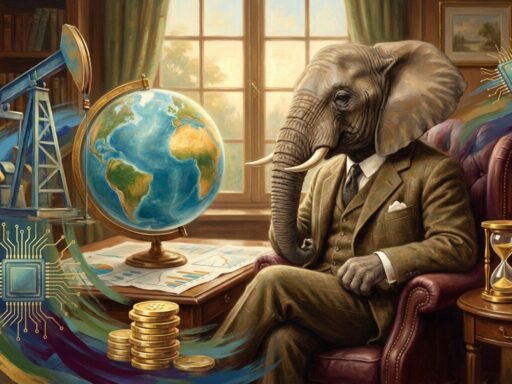



Global markets are currently processing conflicting macroeconomic signals, shifting capital allocations in the technology sector, and elevated geopolitical friction. For Elephants observing these developments, the noise of daily market fluctuations often obscures underlying structural changes. The current environment demands our usual patient methodology. The synthesis of robust employment data, supply chain rerouting, and heavy infrastructure spending requires a long-term perspective to separate enduring trends from short-term volatility.
Macroeconomic crosscurrents and global monetary policy
The United States added 162,000 jobs in August according to recent employment data reported by Bloomberg and Channel News Asia. This resilient labor market data challenges earlier market expectations for immediate and deep monetary easing. While Federal Reserve Governor Christopher Waller indicated to Bloomberg that inflation is cooling toward the central bank’s target, former Federal Reserve Governor Kevin Warsh noted that price pressures remain persistent across the economy.
The bond market is reacting directly to these signals. Global sovereign bond yields are approaching 20-year highs. This widespread sell-off in fixed-income markets is creating immediate fiscal pressure on heavily indebted nations. As DW reports, the rising cost of debt servicing threatens to limit public investment and strain national budgets worldwide. For the patient herd, the higher for longer interest rate environment requires a careful evaluation of corporate balance sheets, specifically favoring entities with low debt dependency and strong cash flow generation.
Geopolitical friction and supply chain realignments
Direct kinetic warfare in the Middle East and ongoing tensions in Eastern Europe are forcing international shipping operators to alter established logistics networks. Japanese shipping firm Nippon Yusen Kaisha is actively rerouting vessels around Africa’s Cape of Good Hope to avoid security risks in the Red Sea. This adjustment adds significant transit time and fuel costs to international voyages, as detailed by Bloomberg.
Trade protectionism is also accelerating. In North America, proposed tariffs threaten the highly integrated manufacturing corridor connecting Detroit and Windsor. Channel News Asia highlights that automotive components frequently cross the border multiple times before final assembly, exposing manufacturers to compounded tariff costs. Simultaneously, China is managing a severe domestic property market contraction by redirecting state capital into advanced manufacturing and green technologies. This pivot has lowered global demand for raw construction commodities while flooding international markets with high-tech industrial exports, according to DW. The resulting trade friction suggests that investors should examine localized supply chains and companies less exposed to cross-border tariff escalations.
The physical infrastructure demands of artificial intelligence
The technology sector is undergoing a massive capital reallocation. The focus is shifting from initial software development to the immense physical infrastructure required to train and operate artificial intelligence models. This transition is highly capital intensive. Bloomberg reports that Dell Technologies recently raised its full-year financial outlook due to surging enterprise orders for high-performance computing hardware.
Corporate consolidation and capitalization in this space are substantial. Artificial intelligence developer Anthropic is nearing a $15 billion credit agreement to finance its compute and infrastructure requirements, while Nvidia is advancing negotiations to acquire open-source platform Hugging Face for $14 billion. National Economic Council Director Kevin Hassett and Commerce Secretary Howard Lutnick have both emphasized the economic necessity of domestic technological infrastructure. The demand for data center expansion, electrical grid capacity, and advanced cooling systems presents long-term secular growth opportunities for utility and industrial companies outside the immediate software sector.
Industrial restructuring and emerging market pressures
Traditional manufacturing is facing severe headwinds. Volkswagen is considering closing production facilities in Germany for the first time in its history. The automaker is struggling with high manufacturing costs, weakening European demand, and intense competition from Chinese electric vehicle brands, as reported by DW. The consumer retail sector is also adjusting. Fast-fashion retailers are encountering signs of consumer fatigue driven by cost-of-living pressures and a gradual shift toward durable garments, according to France 24.
In emerging markets, macroeconomic volatility is forcing corporate realignment. Ride-hailing company Uber is ending operations in Nigeria due to a severely devalued local currency, high inflation, and the removal of national fuel subsidies. The International Monetary Fund recently approved a major loan agreement for Senegal to maintain fiscal stability amid similar economic pressures. Conversely, some conglomerates are focusing on long-term continuity. Nigerian industrialist Aliko Dangote has formally integrated his daughters into executive board positions to secure intergenerational governance for the Dangote Group, an industrial model based on disciplined capital reinvestment and operational self-reliance, as noted by Bloomberg.
Elephant Conclusions for the Herd
The global economy is currently defined by high capital costs, supply chain vulnerabilities, and massive infrastructure spending. For the Elephants in our readership, these conditions reinforce the necessity of a patient, well-researched investment approach. The era of near-zero interest rates is over. The current bond market dynamics favor companies with strong balance sheets and the pricing power to pass elevated operational costs onto consumers.
The artificial intelligence sector is moving past its speculative software phase and into a heavy construction cycle. This requires vast amounts of energy, cooling systems, and raw materials. Investors with a long-term horizon can look toward the secondary beneficiaries of this transition, such as grid infrastructure providers and specialized industrial manufacturers.
Geopolitical conflicts and trade disputes are structurally increasing the cost of global commerce. Relying on complex international logistics is becoming a liability. Businesses that are actively localizing their supply chains and reducing exposure to tariff fluctuations will be better positioned to navigate the coming years. Maintain a steady pace, rely on robust fundamental analysis, and allow your capital the time it needs to compound.
This article was generated by AI based on news reporting from the past week. Please perform your own due diligence before making investment decisions.