
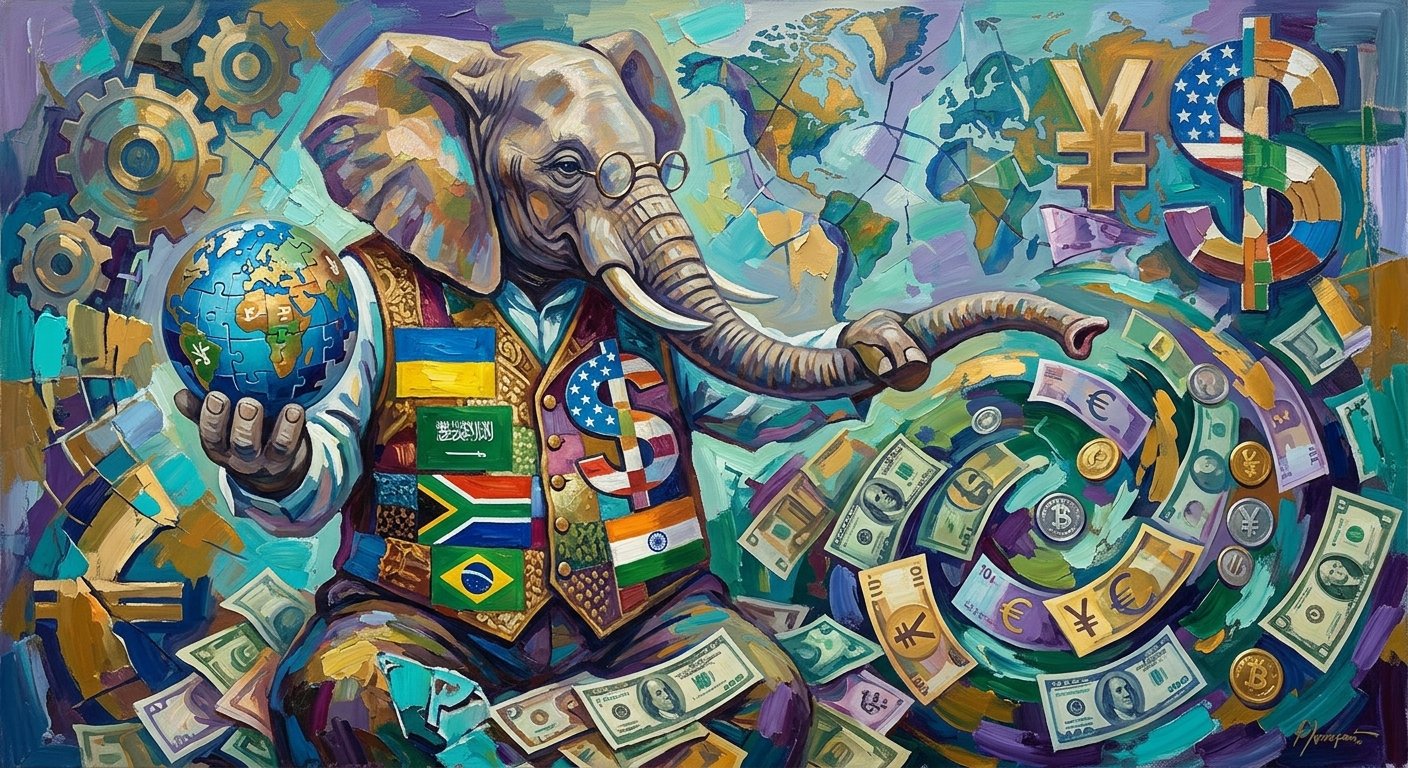

The global macroeconomic environment is currently defined by a profound structural contest over the future of international finance. On one side is a coordinated effort by emerging economies to dismantle the supremacy of the U.S. dollar, while on the other stands the deeply entrenched resilience of the dollar itself, an asset that frequently forces adversarial nations back into its orbit during times of economic stress. For the Elephants reading this report, navigating this shifting terrain requires a long-term perspective, heavy-footed patience, and strict due diligence regarding how geopolitical friction translates into market realities.
Executive Summary
The international financial architecture is undergoing a transformation that carries heavy implications for global capital flows, asset valuations, and risk management. The foundation of the U.S. dollar’s dominance has been fractured by the increasing weaponization of the global financial system. Following the freezing of Russian foreign reserves in 2022, nations within the Global South recognized that holding U.S. debt carries profound political risks, transforming a nation’s accumulated wealth into a potential instrument of economic warfare.1 In response, a de-dollarization movement has accelerated, characterized by aggressive gold accumulation among BRICS central banks and the development of alternative digital payment infrastructures designed to bypass Western financial rails.2
Despite these coordinated efforts, the global economy remains caught in a structural dependency on the U.S. dollar. This paradox is best explained by the Dollar Milkshake Theory, which outlines how the dollar acts as a vacuum for global liquidity during times of crisis, squeezing foreign economies that hold dollar-denominated debt.4 The infrastructural limitations of alternative payment systems like China’s Cross-Border Interbank Payment System (CIPS) further cement this dependency.6 This reality is forcing even the fiercest adversaries of the dollar to acknowledge its stabilizing power, evidenced by internal Kremlin documents from early 2026 exploring a potential return to dollar-based settlements.7
However, a perpetually surging dollar is unsustainable for the global economy, leading to high-level discussions in Washington regarding a coordinated currency devaluation, colloquially termed the Mar-a-Lago Accord.8 This framework attempts to mimic the 1985 Plaza Accord but relies on aggressive tariff threats rather than voluntary global cooperation.9 For Elephants managing institutional or personal wealth, this environment demands a strategic reallocation away from passive domestic concentration. The analysis suggests moving toward hard assets, internationally diversified equities, and active fixed-income management to survive the volatility of a transitioning monetary order.
I. The Weaponization of Finance and the De-Dollarization Rebellion
The mechanics of global reserve management shifted fundamentally following the imposition of sanctions on Russia. The decision by Western nations to freeze approximately $300 billion in Russian foreign exchange reserves served as a stark demonstration to emerging markets.10 It proved that reserves held in dollar-denominated assets or foreign jurisdictions are exposed to extreme geopolitical risk if political alignment breaks down.1 Financial networks, once viewed as neutral public utilities facilitating global trade, are now openly utilized as instruments of state power and coercion.
The Return to Hard Assets and Sovereign Wealth
In response to these perceived vulnerabilities, central banks – particularly those within the BRICS alliance (Brazil, Russia, India, China, and South Africa, alongside newly admitted members) – have initiated a massive divestment from U.S. Treasury bonds while simultaneously executing the most aggressive gold accumulation strategy in modern financial history. Gold functions as a sovereign asset that carries no counterparty risk and cannot be digitally frozen, sanctioned, or seized through Western financial networks.11
By late 2025 and early 2026, this accumulation reached a historic threshold. Gold officially overtook U.S. Treasuries as the world’s largest foreign reserve asset, with central bank holdings approaching the $4 trillion mark.12 This represents a structural shift in portfolio construction for monetary authorities. The BRICS nations and their strategic allies now control approximately 50% of global gold production.14 China and Russia have led this physical acquisition, producing 380 tonnes and 340 tonnes respectively in 2024, while aggressively restricting sales to international markets to retain domestic supply.15
Simultaneously, the divestment from U.S. debt has been severe and measurable. Between October 2024 and October 2025, China, India, and Brazil collectively divested approximately $183.2 billion in U.S. Treasury securities.17 Official data from the U.S. Department of the Treasury shows that China’s holdings fell to $683.5 billion by December 2025, representing a multi-year low as the nation actively diversifies its balance sheet away from dollar exposure.18 India’s holdings of U.S. Treasuries also fell below the $200 billion mark, declining to around $190.4 billion by January 2026, a sharp drop compared to previous years.18
This divestment is not uniform globally. While the Global South rotates into physical metals, traditional U.S. allies are accumulating American debt. The United Kingdom, Belgium, and Japan were the three largest buyers of U.S. debt during the same 2024 – 2025 period, each increasing their holdings by more than $115 billion.19 This divergence highlights a bifurcating global financial system where capital allocation is increasingly determined by geopolitical alliances rather than pure economic yield.
| Metric | Physical Gold | U.S. Treasury Bonds |
| Counterparty Risk | None | High (Subject to U.S. policy and debt ceilings) |
| Sanction Vulnerability | Low (When stored in domestic vaults) | High (Digitally tracked and easily frozen) |
| Inflation Protection | High (Maintains purchasing power over centuries) | Low (Subject to central bank monetary debasement) |
| Global Reserve Status | Surpassed U.S. debt in total value in late 2025 13 | Total volume increasing, but share among BRICS declining |
Digital Currency and Alternative Payment Infrastructures
The accumulation of physical gold is running in parallel with the aggressive development of alternative digital infrastructures. Emerging nations are actively piloting Central Bank Digital Currencies (CBDCs) to facilitate cross-border trade without touching the U.S. dollar or relying on the SWIFT messaging system.
China’s digital yuan (the e-CNY) has become the world’s largest live CBDC experiment. By late 2025, the digital yuan had processed over 3.4 billion transactions with a cumulative value exceeding 16.7 trillion renminbi (approximately $2.3 trillion).3 This represents an 800% increase in transaction volume from 2023.3 The People’s Bank of China recently transitioned the e-CNY from a simple digital cash model to a digital deposit model that pays interest to holders, making the asset highly attractive for institutional holding and cross-border trade finance.21 India has also expanded the pilot phase of its e-Rupee, which has attracted roughly 7 million retail users.22 The Reserve Bank of India has officially proposed a framework to link BRICS CBDCs to make cross-border trade and tourism payments cheaper and faster, aiming to place this interoperability plan on the agenda for the 2026 BRICS summit.23
The most advanced multilateral infrastructure currently operating is Project mBridge. Originally developed in coordination with the Bank for International Settlements (BIS), the platform allows multiple central banks to issue and exchange wholesale CBDCs directly on a shared distributed ledger.25 By November 2025, mBridge had processed over 4,000 cross-border transactions worth $55.49 billion, a 2,500-fold increase over its early 2022 pilot phases.3 The digital yuan accounts for roughly 95% of the total settlement volume on the platform.26
In a highly symbolic move in October 2024, the BIS unexpectedly withdrew from Project mBridge, stating the platform had “graduated” from its Innovation Hub.26 This departure left the infrastructure entirely under the operational control of participating nations, which include China, the United Arab Emirates, Thailand, and Saudi Arabia.27 The success of mBridge proves that technologically viable alternatives to the dollar-based correspondent banking system now exist and are actively clearing billions in sovereign and corporate capital.
II. The Vulnerabilities of the Dollar and Historical Precedents
To understand the long-term risks to the U.S. dollar, Elephants must look backward. The pressures currently facing the greenback are not entirely novel. The international monetary system has witnessed the rise and fall of several dominant reserve currencies over the past six centuries. The Portuguese real, the Spanish silver real, the Dutch guilder, and the British pound all enjoyed periods of global supremacy before eventually succumbing to excessive debt, policy mismanagement, and geopolitical shifts.28
Lessons from the Dutch Guilder
The Dutch guilder, managed by the Bank of Amsterdam, was the dominant currency in Europe during the 17th and 18th centuries.29 The guilder enjoyed what modern economists call “exorbitant privilege” – the ability of the issuing nation to borrow and lend on vastly more favorable terms than competing countries.30 Foreign investors were eager to exchange their surpluses for financial assets in the Netherlands, providing the Dutch economy with massive deposits and deep liquidity.30
However, archival reconstructions of the Bank of Amsterdam’s balance sheets reveal a stark warning for modern central banks. The guilder was ultimately weakened by highly accommodative open market and credit policies combined with ongoing fiscal exploitation by the City of Amsterdam.29 By 1784, these accommodative policies rendered the Bank policy insolvent, meaning its net worth would have been negative under the continuation of its traditional policy objectives.31 Policy insolvency coincided directly with the Bank’s loss of control over the value of its money, and the guilder was rapidly forced off the world stage, replaced by the British pound.29
The Decline of the British Pound
The British pound enjoyed uncontested global reserve status following 1815, supported by the world’s largest gold reserves and Britain’s industrial supremacy.32 However, the exorbitant privilege of reserve status eventually mutated into an exorbitant burden. The financial strain of World War I forced Britain off the gold standard and severely weakened its creditor position.
Contrary to popular narratives of a sudden shift, the transition from the British pound to the U.S. dollar was a drawn-out process spanning decades. Throughout the interwar period of the 1920s and 1930s, the pound and the U.S. dollar shared reserve status almost equally, forming a global currency oligopoly.33 The ultimate transition to dollar dominance was driven heavily by the superior depth, scale, and liquidity of U.S. financial markets, alongside America’s emergence as a primary creditor nation unburdened by the destruction of the European continent.34
| Reserve Currency | Approximate Era of Dominance | Primary Catalysts for Decline |
| Portuguese Real | 1400 – 1530 | Overextension of empire, loss of trade monopolies 28 |
| Spanish Real | 1530 – 1640 | Massive inflation from colonial silver, sovereign defaults 28 |
| Dutch Guilder | 1640 – 1720 | Accommodative credit policies, state fiscal exploitation 28 |
| British Pound | 1815 – 1920 | War debts, loss of industrial supremacy, rise of U.S. markets 28 |
| U.S. Dollar | 1920 – Present | Rising national debt, Triffin dilemma, weaponization of finance 28 |
The Triffin Dilemma and Modern U.S. Fiscal Realities
The U.S. dollar currently faces the exact structural paradox that eventually weakens all reserve currencies, famously outlined by economist Robert Triffin in the 1960s. The Triffin dilemma dictates that a nation issuing a global reserve currency faces a permanent conflict between short-term national interests and long-term international objectives.35 To provide the world with sufficient liquidity for international trade, the United States must run perpetual current account deficits, constantly exporting its currency abroad. In the long term, this status allows the U.S. to consume far more than it produces, but it simultaneously encourages domestic deindustrialization and results in massive accumulations of sovereign debt.35
As of early 2026, the U.S. national debt approaches $39.01 trillion, representing roughly 125% of the nation’s Gross Domestic Product.37 The speed of this debt accumulation is accelerating, with the most recent trillion dollars added in roughly five months.37 Interest payments on this federal debt now surpass the entire U.S. defense budget.38 The Congressional Budget Office estimates that annual budget deficits will remain elevated, pushing the national debt toward $64 trillion within a decade.37
This fiscal trajectory, combined with frequent domestic political brinkmanship regarding debt ceilings and government shutdowns, raises fundamental questions about the long-term safety of U.S. Treasury bonds.36 If investors lose confidence in the Treasury market, the U.S. could face a sovereign debt crisis characterized by a spike in interest rates, a freezing of credit, and sudden currency depreciation.36
Counter-Arguments: The Enduring Moat of the Dollar
Despite these severe vulnerabilities, reports of the dollar’s immediate demise are often exaggerated. According to the IMF’s Currency Composition of Official Foreign Exchange Reserves (COFER) data from late 2025, the U.S. dollar still accounts for 56.77% of global allocated reserves.40 While this is a decline from its peak of 72% in 2001, it remains the dominant asset by a massive margin compared to the Euro (20.25%) and the Chinese Renminbi (1.95%).40
The dollar is protected by a wide structural moat. First, the U.S. benefits from a superior rule-of-law framework. According to the World Justice Project Rule of Law Index 2025, G7 nations consistently rank at the top of global metrics for constraints on government powers, absence of corruption, and regulatory enforcement.42 In contrast, BRICS nations score poorly on investor protection and legal transparency, making global institutions hesitant to hold massive wealth in their jurisdictions.44
Second, the demographic realities of competing nations hinder their ability to host a global reserve. China is facing a severe population upheaval. The nation’s old-age dependency ratio is projected to double by 2041, and its working-age population is expected to contract from 840 million to 614 million by 2050.45 This demographic collapse will drastically reduce Chinese productivity and profitability, limiting the long-term viability of the Yuan as a global anchor.46 The U.S., despite its debt load, maintains a relatively stable demographic profile supported by immigration and a highly dynamic technology sector.
III. The Dollar Milkshake and the Liquidity Trap
To understand why the global economy struggles to abandon the greenback despite its vulnerabilities, Elephants must examine the mechanics of global liquidity. The world remains trapped in a structural dependency on the dollar, a phenomenon encapsulated by the “Dollar Milkshake Theory,” a macroeconomic framework developed by investment manager Brent Johnson of Santiago Capital.4
The Mechanics of the Squeeze
The Dollar Milkshake Theory posits that the global financial system is fundamentally trapped by dollar-denominated debt.47 Because the vast majority of international trade and foreign corporate borrowing is conducted in U.S. dollars, the world fundamentally relies on a constant flow of American currency just to service its interest payments.4
In this framework, the U.S. dollar acts as a massive vacuum – a straw – sucking up global liquidity.5 When a geopolitical or economic shock occurs – such as conflicts in the Middle East that threaten the Strait of Hormuz – energy supplies are threatened, causing crude oil prices to spike.37 Because oil is priced and traded in dollars, energy-importing nations require immediate emergency liquidity in USD to secure their energy grids.48
To acquire these necessary dollars, foreign central banks and corporate institutions are forced to liquidate their local assets, sell their domestic currencies, and occasionally draw down their gold reserves. This dynamic creates a massive short squeeze. As the world desperately bids up the price of the dollar to pay for energy and service debt, foreign fiat currencies collapse, and the dollar artificially surges.5
The U.S. dollar strengthens during these crises not necessarily because of superior American economic performance or technological innovation, but due to the inescapable financial gravity of the existing debt architecture.47 For a foreign corporation that borrowed $100 million in USD when their local currency was strong, a 30% surge in the dollar’s value makes that debt crushingly expensive to repay, leading to regional defaults and further capital flight back to the perceived safety of the United States.5
Stablecoins: The Second Straw
In a fascinating update to the Dollar Milkshake framework for 2026, cryptocurrency and stablecoins have emerged as a secondary mechanism reinforcing dollar dominance. Originally championed by technologists as a decentralized weapon to escape fiat currency, dollar-pegged stablecoins actually create massive, locked-in demand for U.S. government debt.49
When citizens in emerging markets experience hyperinflation, they increasingly convert their local currency into dollar-pegged stablecoins (such as USDT or USDC) via mobile applications to protect their savings. Because stablecoin issuers are legally required to back these digital tokens with safe, liquid assets, they purchase short-dated U.S. Treasury bills.49 Therefore, every time an individual in the Global South uses a stablecoin to escape their local fiat, they are indirectly funding the U.S. government. This technological innovation acts as a second straw, extending the reach of the dollar directly into the digital wallets of billions of people globally, wiring even more structural demand into the U.S. Treasury market.49
The Infrastructure Reality: SWIFT vs CIPS
The physical infrastructure of global payments further restricts the ability of adversarial nations to abandon the dollar system. While China has successfully built the Cross-Border Interbank Payment System (CIPS) to facilitate independent renminbi settlement, the sheer scale of the network remains dwarfed by Western alternatives.50
As of early 2026, CIPS connects 193 direct participants and 1,573 indirect participants.51 In stark contrast, the SWIFT messaging network connects over 11,000 financial institutions across more than 200 countries.50 While CIPS is growing rapidly – processing 175.49 trillion yuan ($24.45 trillion) across 8.2 million transactions in 2024 – it lacks the universal coverage required to fully replace SWIFT in the global economy.52
More importantly, CIPS is not entirely independent. An estimated 80% of payments routed through CIPS still rely on the SWIFT network to send secure messaging instructions between indirect participant banks.53 SWIFT acts as the messaging protocol (instructing Bank A to pay Bank B), while CIPS functions as a Real-Time Gross Settlement (RTGS) system that actually moves the funds.50 Because CIPS relies heavily on SWIFT for communication, institutions using CIPS remain highly vulnerable to secondary sanctions imposed by Western governments.53 In a fast-moving liquidity crisis, capital flows through the deepest and most reliable pipes, which overwhelmingly lead back to the dollar.
| System Feature | SWIFT | CIPS |
| Primary Function | Secure Messaging Protocol (Does not move funds) 6 | Clearing and Settlement (RTGS system) 50 |
| Participant Count | 11,000+ globally 50 | 193 Direct, 1,573 Indirect 51 |
| Currency Focus | Currency Agnostic (Dominantly USD/EUR) 50 | Renminbi (RMB) Centric 50 |
| Operational Independence | Independent global infrastructure | Relies heavily on SWIFT for messaging between indirect banks 53 |
IV. Geopolitical Pragmatism and the Endgame
The inescapable reality of the Dollar Milkshake creates severe friction for nations attempting to operate entirely outside the U.S. financial system. The practical difficulties of settling massive trade imbalances in illiquid local currencies frequently force nations into pragmatic compromises, proving that economic necessity often overrides ideological posturing.
The Leaked Kremlin Memorandum
This dynamic was starkly illuminated in February 2026, when a leaked internal Kremlin memorandum revealed that Russia was actively considering a return to the U.S. dollar settlement system.7 The document, prepared by Kirill Dmitriev, the head of Russia’s sovereign wealth fund, circulated among senior Russian officials and proposed a broad $12 trillion economic partnership with the United States in exchange for sweeping sanctions relief.54
The “Dmitriev package” outlined seven key areas of potential cooperation.55 These proposals included long-term contracts to modernize Russia’s commercial aircraft fleet using American planes, joint ventures in hard-to-recover offshore oil extraction, and cooperation regarding critical raw materials like lithium, copper, and palladium.55
At the very core of the memo was a request to restore Russia’s access to dollar-based transactions. The memo explicitly noted that reintegrating into the dollar system would stabilize Russia’s balance of payments and foreign exchange markets, lowering the extreme import costs caused by utilizing secondary currencies.57
This leak represents a staggering reversal from Moscow’s aggressive de-dollarization rhetoric.58 For years, President Vladimir Putin framed the dollar as a toxic weapon of Western coercion.58 While BRICS nations currently manage to settle roughly 60% to 67% of their intra-bloc trade in local currencies, the friction of holding excess, non-convertible rupees or yuan limits the utility of these trade corridors.56 The Kremlin’s willingness to re-engage with the dollar highlights a fundamental truth of global finance: ideological alignment cannot overcome the mathematical necessity of deep, liquid settlement markets. A Russian return to dollar settlements would heavily undermine arguments that alternative platforms like BRICS Pay are scalable at global levels, severely dampening the momentum of the de-dollarization movement.56
Plaza Accord 2.0 and the Mar-a-Lago Discussions
The paradox facing the United States is that while the Dollar Milkshake traps foreign capital, a perpetually hyper-strong dollar is deeply destructive to the domestic American economy. A strong dollar makes U.S. exports uncompetitive on the global market, accelerates the offshoring of manufacturing jobs, and drastically widens the trade deficit. This dynamic has sparked intense policy debates in Washington regarding a coordinated, strategic devaluation of the currency.
In 1985, the United States faced a similar manufacturing crisis caused by an overvalued dollar. In response, the U.S. government convened with France, West Germany, Japan, and the United Kingdom at the Plaza Hotel in New York. The resulting Plaza Accord was a landmark agreement to jointly intervene in currency markets to deliberately weaken the dollar.59 The strategy succeeded; the dollar fell by roughly 40% against the yen and the deutschmark over the following two years, boosting American industrial competitiveness.59
As 2025 transitioned into 2026, discussions surrounding a “Plaza Accord 2.0” – colloquially dubbed the “Mar-a-Lago Accord” – gained significant traction in financial circles.8 The conceptual framework for this accord was outlined by Stephen Miran, a prominent economic advisor, in a paper exploring the restructuring of the global trading system.9
The proposed Mar-a-Lago Accord seeks to intentionally devalue the dollar to revitalize U.S. industrial capacity. However, because foreign nations are highly unlikely to voluntarily appreciate their own currencies (which would damage their own export economies), the framework suggests using universal tariffs as a coercive tool.60 Under this strategy, foreign nations would face punishing tariffs on their goods entering the U.S. market unless they agree to stop hoarding U.S. dollars and allow their local currencies to strengthen against the greenback.60
The proposal also explores explicitly linking geopolitical security to economic compliance. Nations operating under the protection of the U.S. military defense umbrella might be required to purchase ultra-long-term U.S. Treasury bonds (such as 50-year or 100-year maturity vehicles) to fund the security they receive, effectively subsidizing U.S. debt.61
Despite the theoretical appeal of rebalancing global trade, implementing a Plaza Accord 2.0 in the modern era faces massive logistical and economic hurdles. In 1985, capital markets were vastly smaller, and central banks exerted far more direct control over exchange rates. Today, algorithm-driven foreign exchange markets trade over $7.5 trillion daily, making coordinated intervention incredibly difficult to sustain.59 Furthermore, the global economy is highly multipolar; attempting to force a currency revaluation without the direct cooperation of China is mathematically implausible.62
If the U.S. administration attempts to force a devaluation through unilateral actions, sudden tariffs, or by taxing foreign investments, the resulting loss of confidence could trigger intense market volatility. A sudden drop in foreign demand for U.S. Treasuries would cause bond yields to spike rapidly, drastically increasing the borrowing costs for U.S. corporations, freezing credit markets, and potentially triggering a severe domestic recession.63
V. Macro-Level Impacts and Investment Due Diligence
For the Elephants observing this structural shift, the investment environment requires a distinct departure from the strategies that dominated the past decade. The era of passive reliance on U.S. mega-cap technology stocks and traditional 60/40 equity-to-bond portfolios is giving way to a landscape that demands active management, geographical diversification, and heavy allocations to tangible, hard assets.
The “Sell America” Trade and International Diversification
The combination of extreme U.S. equity valuations, rising fiscal deficits, and deliberate policy efforts to weaken the dollar has accelerated what analysts term the “Sell America” trade.65 As global capital looks for better relative valuations, international equities present a compelling opportunity. European and Asian assets currently trade at moderate valuations compared to their U.S. peers.66
Furthermore, if a Mar-a-Lago style devaluation successfully weakens the dollar, international investments will receive an automatic performance boost when those foreign returns are translated back into USD for American investors. Emerging Market (EM) equities, particularly in Asia, hold strong structural conviction. Despite geopolitical friction and tariff threats, Asia remains central to the global supply chain, commanding leadership in semiconductor manufacturing, energy infrastructure, and cost-efficient artificial intelligence deployment.67
The Ascendance of Hard Assets and Critical Minerals
The global movement toward supply chain reshoring and national security directly benefits companies involved in critical infrastructure and raw materials. The electrification of the global energy grid, combined with the massive power requirements of AI data centers, guarantees sustained demand for base metals like copper and lithium.68
Mining equipment manufacturers and heavy industrial firms are positioned to capture this wave of capital expenditure. European utility companies that combine regulated earnings with visible infrastructure growth also act as a defensive compounder in this volatile environment.70 The defense sector continues to benefit from increased sovereign spending, as nations across Europe and Asia recognize that the U.S. security umbrella may come with heavy financial stipulations in the future, prompting massive domestic rearmament.71
The Fixed Income Reality and Active Management
The fixed income landscape has been permanently altered by post-pandemic inflation, massive sovereign debt issuance, and the shifting dynamics of the U.S. Treasury market. The traditional negative correlation between stocks and bonds has flattened, meaning long-duration Treasury bonds no longer provide reliable downside protection during equity market sell-offs.72 When inflation or deficit fears spike, equities and long-term bonds frequently sell off simultaneously, undermining the safety of traditional portfolios.73
In this environment, investors must avoid passive duration exposure. Instead, the focus must shift to active fixed-income management that can harvest yield from the short end of the curve while carefully navigating credit risks. Emerging market debt, particularly local currency sovereign bonds, offers a strong source of income and alpha. These assets benefit directly from any sustained weakness in the U.S. dollar and offer diversification away from the fiscal concerns plaguing Western governments.74
VI. Investment Vehicles and Portfolio Construction
Executing a portfolio strategy aligned with this macroeconomic thesis involves selecting specific, targeted investment vehicles. Elephants should focus on long-term wealth preservation, geographical diversification, and value capture rather than short-term trading trends.
1. Gold and Precious Metal Miners Gold has fully transitioned from a simple inflation hedge to a sovereign risk hedge. While physical bullion provides baseline protection and capital preservation, gold mining equities offer leveraged upside to the metal’s price appreciation.76 Mining companies enter 2026 with pristine balance sheets, strong free cash flow yields, and disciplined capital allocation.77
- SGDM (Sprott Gold Miners ETF): Provides targeted exposure to large-cap, established gold miners. The methodology prioritizes companies with strong revenue growth and low debt-to-equity ratios, screening for quality in an industry historically prone to capital destruction.76
- SGDJ (Sprott Junior Gold Miners ETF): Targets small-cap exploration and early-production companies. This vehicle offers higher volatility but exponentially greater margin expansion when gold spot prices rise.76
- Individual Equities: Companies like Barrick Gold and Agnico Eagle Mines, which demonstrate operational excellence and high free cash flow yields, generally outpace broader passive indexes.77
2. International and Emerging Market Equities
To capture the benefits of potential dollar depreciation and attractive foreign valuations, investors should allocate capital to broad international funds that escape the concentration risk of the U.S. market.
- VXUS (Vanguard Total International Stock ETF): The standard “buy-it-all” option for ex-U.S. exposure. It tracks over 8,600 stocks across both developed and emerging markets, providing an instant hedge against domestic U.S. underperformance.79
- IXUS (iShares Core MSCI Total International Stock ETF): A direct alternative providing low-cost access to a broad range of international companies, ensuring global diversification.67
- VSS (Vanguard FTSE All-World ex-US Small-Cap ETF): Captures the growth potential of international small-cap companies, which are often more closely tied to local economic growth and domestic consumption than massive, dollar-dependent multinationals.79
- IEMG (iShares Core MSCI Emerging Markets ETF): Provides comprehensive access to emerging market equities, heavily weighted toward the Asian manufacturing, logistics, and technology sectors driving global growth.67
3. Active Fixed Income and Real Assets
With the U.S. yield curve subject to severe policy distortions and inflation risks, active management in the bond market is essential for capital preservation.
- BINC (iShares Flexible Income Active ETF): An actively managed vehicle designed to navigate interest rate volatility. It finds high income potential across various global fixed-income sectors rather than passively tracking a flawed aggregate index laden with low-yield government debt.80
- Multi-Asset Real Return Strategies: Actively managed funds, such as the Astoria Real Assets ETF (PPI), that combine real assets, inflation-linked bonds, and commodity exposure provide a comprehensive hedge against fiat debasement and geopolitical shocks.81
| Investment Category | Recommended Vehicle / Ticker | Primary Strategic Function |
| Large-Cap Gold Miners | SGDM | Leveraged exposure to gold prices with a focus on balance sheet quality and free cash flow 76 |
| Junior Gold Miners | SGDJ | High-growth potential from exploration discoveries and rapid margin expansion 76 |
| Broad International Equity | VXUS / IXUS | Massive geographical diversification away from U.S. asset concentration 67 |
| Emerging Market Equity | IEMG | Capturing structural growth in Asian technology, manufacturing, and supply chains 67 |
| Active Fixed Income | BINC | Dynamic yield generation while actively managing duration and sovereign interest rate risk 80 |
Elephant Conclusions for the Herd
The geopolitical landscape of money is currently defined by intense friction, structural paradoxes, and a slow, agonizing transition. The weaponization of the international financial system has triggered a logical, defensive reaction from the Global South, resulting in historic central bank gold accumulation and the steady, undeniable construction of alternative digital payment ledgers like mBridge.
However, the sheer financial gravity of dollar-denominated debt ensures that the U.S. dollar will not vanish overnight. Instead, through the mechanics of the Dollar Milkshake, it will violently squeeze global liquidity during moments of panic, punishing nations and corporations carrying unhedged dollar liabilities. The recent leaked memos from the Kremlin regarding a potential return to dollar settlements prove that ideological declarations of de-dollarization frequently shatter against the mathematical reality of global trade requirements.
For the heavy-footed investors in the herd, this environment requires disciplined pragmatism. Recognize that the U.S. fiscal trajectory, the breakdown of stock and bond correlations, and the explicit political desire in Washington to devalue the dollar pose severe risks to portfolios heavily concentrated in domestic U.S. equities and passive, long-duration Treasuries.
The path forward involves building a resilient portfolio anchored in hard assets, particularly high-quality gold miners that generate substantial free cash flow. It requires diversifying across global borders through broad international ETFs to capture the benefits of the “Sell America” trade, and demanding active management in fixed income to avoid the traps of an unpredictable and politicized yield curve. By maintaining a long memory, conducting strict due diligence, and refusing to stampede with the daily headlines, the herd can safely navigate the complex, volatile unwinding of global dollar hegemony.
Sources
- BRICS nations control 50% of global gold output in shift away from US dollar, accessed on March 28, 2026, https://www.intellinews.com/brics-nations-control-50-of-global-gold-output-in-shift-away-from-us-dollar-417952/
- BRICS Nations Shift Focus from US Treasuries to Gold Reserves – Binance, accessed on March 28, 2026, https://www.binance.com/en/square/post/02-07-2026-brics-nations-shift-focus-from-us-treasuries-to-gold-reserves-289045864625138
- What to watch as China prepares its digital yuan for prime time – Atlantic Council, accessed on March 28, 2026, https://www.atlanticcouncil.org/blogs/econographics/what-to-watch-as-china-prepares-its-digital-yuan-for-prime-time/
- Dollar Milkshake Theory Is Still Useful – Fair Observer, accessed on March 28, 2026, https://www.fairobserver.com/economics/dollar-milkshake-theory-is-still-useful/
- The Dollar Milkshake Theory: What It Means for Gold, Silver, and Your Portfolio, accessed on March 28, 2026, https://goldsilver.com/industry-news/article/the-dollar-milkshake-theory-what-it-means-for-gold-silver-and-your-portfolio/
- Why China’s CIPS Matters (and Not for the Reasons You Think) | CNAS, accessed on March 28, 2026, https://www.cnas.org/publications/commentary/why-chinas-cips-matters-and-not-for-the-reasons-you-think
- Russia considering restarting use of dollar as part of Trump-Putin business package, accessed on March 28, 2026, https://www.intellinews.com/russia-considering-restarting-use-of-dollar-as-part-of-trump-putin-business-package-425761/
- Mar-a-Lago Accord, FX Views, CNY – Northern Trust, accessed on March 28, 2026, https://www.northerntrust.com/content/dam/northerntrust/corporate/global/en/documents/web/pdf/2025/weekly-economic-commentary/mar-a-lago-accord-fx-views-cny-0328.pdf
- US Watch – Tariffs are not the endgame | ABN AMRO, accessed on March 28, 2026, https://www.abnamro.com/research/en/our-research/us-watch-tariffs-are-not-the-endgame
- Why are the BRICS accumulating gold?, accessed on March 28, 2026, https://bricsbrasil.com.br/en/why-are-the-brics-accumulating-gold/
- Central Bank Gold Buying Reaches Historic Highs – Discovery Alert, accessed on March 28, 2026, https://discoveryalert.com.au/strategic-reserve-rebalancing-monetary-uncertainty-2026/
- Gold overtakes U.S. Treasuries as the world’s largest foreign reserve asset in 2026 — can gold challenge the U.S. dollar’s dominance and hold its ground? – The Economic Times, accessed on March 28, 2026, https://m.economictimes.com/news/international/us/gold-overtakes-u-s-treasuries-as-the-worlds-largest-foreign-reserve-asset-in-2026-can-gold-challenge-the-u-s-dollars-dominance-and-hold-its-ground/articleshow/126420128.cms
- Gold overtakes US bonds as largest foreign reserve asset – MINING.COM, accessed on March 28, 2026, https://www.mining.com/gold-overtakes-us-bonds-as-largest-foreign-reserve-asset/
- BRICS Gold Rush Reshapes Global Finance Power Balance – Evrim Ağacı, accessed on March 28, 2026, https://evrimagaci.org/gpt/brics-gold-rush-reshapes-global-finance-power-balance-520872
- BRICS Countries Hold Half of World’s Gold Reserves: Implications for US Dollar, accessed on March 28, 2026, https://www.brics-info.org/08250bbe6617dbf603175c7de047c721/
- BRICS’ 2026 Gold Plan Aims for 65–70% of Output — What It Means for Crypto – Binance, accessed on March 28, 2026, https://www.binance.com/ar/square/post/34985875408442
- China, India, and Brazil Reduce U.S. Treasury Holdings, Boost Gold Reserves – Binance, accessed on March 28, 2026, https://www.binance.com/en/square/post/02-02-2026-china-india-and-brazil-reduce-u-s-treasury-holdings-boost-gold-reserves-35909492497577
- Table 5: Major Foreign Holders of Treasury Securities, accessed on March 28, 2026, https://ticdata.treasury.gov/resource-center/data-chart-center/tic/Documents/slt_table5.html
- Ranked: The Biggest Buyers and Sellers of U.S. Debt (2025) – Visual Capitalist, accessed on March 28, 2026, https://www.visualcapitalist.com/whos-buying-and-selling-americas-debt-2025/
- Amid global gold rush, India and China are dumping US treasuries – The Economic Times, accessed on March 28, 2026, https://m.economictimes.com/news/india/amid-global-gold-rush-india-and-china-are-dumping-us-treasuries/articleshow/126693854.cms
- China gives up on state-backed digital cash: The US and Europe should take note—for different reasons – Peterson Institute for International Economics, accessed on March 28, 2026, https://www.piie.com/blogs/realtime-economics/2026/china-gives-state-backed-digital-cash-us-and-europe-should-take-note
- Central Bank Digital Currency Statistics 2026: Insights – SQ Magazine, accessed on March 28, 2026, https://sqmagazine.co.uk/central-bank-digital-currency-statistics/
- BRICS payment rails get CBDC upgrade under India plan, accessed on March 28, 2026, https://paymentexpert.com/2026/01/20/india-cbdc-upgrade-brics-payment-rail/
- How Would a New BRICS Currency Affect the US Dollar? | INN – Investing News Network, accessed on March 28, 2026, https://investingnews.com/brics-currency/
- Project mBridge reached minimum viable product stage – Bank for International Settlements, accessed on March 28, 2026, https://www.bis.org/about/bisih/topics/cbdc/mcbdc_bridge.htm
- China-led cross-border CBDC platform mBridge surges past $55 billion in transaction volume: Reuters | The Block, accessed on March 28, 2026, https://www.theblock.co/post/386057/china-led-cross-border-cbdc-platform-mbridge-surges-past-55-billion-in-transaction-volume-reuters
- mBridge Is the Global Payment Revolution that will upset the Western Financial Order | by Thomas Karat – Medium, accessed on March 28, 2026, https://medium.com/@thomas.s.karat/europes-wake-up-call-why-mbridge-should-terrify-brussels-more-than-it-does-3d416715dd25
- What Happens When a World Reserve Currency Declines – And How to Protect Your Wealth, accessed on March 28, 2026, https://citrinecapitaladvisors.com/blog/world-reserve-currency-decline-wealth-protection
- Death of a Reserve Currency*, accessed on March 28, 2026, https://allucgroup.ucdavis.edu/uploads/5/6/8/7/56877229/deathofareservecurrency.pdf
- Dutch Treat: The Netherlands’ Exorbitant Privilege in the Eighteenth Century, accessed on March 28, 2026, https://libertystreeteconomics.newyorkfed.org/2025/10/dutch-treat-the-netherlands-exorbitant-privilege-in-the-eighteenth-century/
- Death of a Reserve Currency | International Journal of Central Banking, accessed on March 28, 2026, https://www.ijcb.org/journal/v12n4/death-reserve-currency
- Safe Haven Currencies: The Complete History | The Capital Dispatch – Trade FX, Cfd’s, Stocks, BTC, Indices, Gold & Oil, accessed on March 28, 2026, https://www.capitalstreetfx.com/safe-haven-currencies-the-complete-history/
- The Rise and Fall of the Dollar, or When did the Dollar Replace Sterling as the Leading Reserve Currency? – University of California, Berkeley, accessed on March 28, 2026, https://eml.berkeley.edu/~eichengr/rise_fall_dollar_temin.pdf
- When did the dollar overtake sterling as the leading international currency? Evidence from the bond markets – European Central Bank, accessed on March 28, 2026, https://www.ecb.europa.eu/pub/pdf/scpwps/ecbwp1433.pdf
- May 15, 2025, accessed on March 28, 2026, https://20286994.fs1.hubspotusercontent-na1.net/hubfs/20286994/In-Gold-We-Trust-report-2025-english%20(EDIT).pdf
- What Would a Fiscal Crisis Look Like? | Committee for a Responsible Federal Budget, accessed on March 28, 2026, https://www.crfb.org/papers/what-would-fiscal-crisis-look
- War, oil and the dollar: The war comes home. Iran War Briefing #26, accessed on March 28, 2026, https://www.counterfire.org/article/war-oil-and-the-dollar-the-war-comes-home-iran-war-briefing-26/
- Why the US dollar will be indispensible as the world’s reserve currency – until it’s not, accessed on March 28, 2026, https://www.weforum.org/stories/2025/01/us-dollar-will-be-indispensable-until-not/
- What Happens When the U.S. Hits Its Debt Ceiling? | Council on Foreign Relations, accessed on March 28, 2026, https://www.cfr.org/backgrounders/what-happens-when-us-hits-its-debt-ceiling
- Currency Composition of Official Foreign Exchange Reserves – IMF Data Brief, accessed on March 28, 2026, https://data.imf.org/en/news/imf%20data%20brief%20march%2027
- US dollar continues its gradual decline as the world’s reserve currency – Maaal, accessed on March 28, 2026, https://maaal.com/en/news/details/us-dollar-continues-its-g/
- WJP Rule of Law Index (2025), accessed on March 28, 2026, https://worldjusticeproject.org/rule-of-law-index/downloads/WJPIndex2025.pdf
- Countries Ranked by Overall Score – WJP Rule of Law Index | Global Insights, accessed on March 28, 2026, https://worldjusticeproject.org/rule-of-law-index/global/2025/table
- ‘De-Dollarization’? Don’t Believe the Hype – ETF Trends, accessed on March 28, 2026, https://www.etftrends.com/etf-strategist-content-hub/de-dollarization-dont-believe-the-hype/
- Population Aging and Pension Reforms in China in: IMF Working Papers Volume 2026 Issue 027 (2026), accessed on March 28, 2026, https://www.elibrary.imf.org/view/journals/001/2026/027/article-A001-en.xml
- How Severe Are China’s Demographic Challenges? – ChinaPower Project, accessed on March 28, 2026, https://chinapower.csis.org/china-demographics-challenges/
- What is the Dollar Milkshake Theory, accessed on March 28, 2026, https://www.mexc.com/learn/article/what-is-the-dollar-milkshake-theory/1
- De-Dollarization and Gold: Central Bank Reserve Trends – Discovery Alert, accessed on March 28, 2026, https://discoveryalert.com.au/de-dollarization-gold-markets-2026-trends/
- THE DOLLAR MILKSHAKE: WHY THE NEXT CRISIS MAKES AMERICA RICHER AND CANADA POORER – YouTube, accessed on March 28, 2026, https://www.youtube.com/watch?v=Gy3byXin3Vo
- CIPS vs SWIFT: 5 Key Differences Explained – Native Teams, accessed on March 28, 2026, https://nativeteams.com/blog/cips-vs-swift-key-differences
- MNCs drive expansion of China’s CIPS – Chinadaily.com.cn, accessed on March 28, 2026, https://www.chinadaily.com.cn/a/202603/03/WS69a642bea310d6866eb3b485.html
- Is China’s cross-border payments network on the rise? – FXC Intelligence, accessed on March 28, 2026, https://www.fxcintel.com/research/analysis/cips-growth-may-2025
- Sanctions, SWIFT, and China’s Cross-Border Interbank Payments System – CSIS, accessed on March 28, 2026, https://www.csis.org/analysis/sanctions-swift-and-chinas-cross-border-interbank-payments-system
- Russia confirms $12 trillion pitch to Trump tied to Ukraine deal — White House stays silent on proposals – The Kyiv Independent, accessed on March 28, 2026, https://kyivindependent.com/russia-confirms-12-trillion-pitch-to-trump/
- Kremlin pitches return to USD in U.S. partnership deal / The New Voice of Ukraine, accessed on March 28, 2026, https://english.nv.ua/nation/kremlin-pitches-return-to-usd-in-u-s-partnership-deal-50583422.html
- Russia may return to US dollar settlement system in Trump deal: what the proposed US – Russia economic partnership includes and is BRICS de-dollarization now a dead game?, accessed on March 28, 2026, https://m.economictimes.com/news/international/us/russia-may-return-to-us-dollar-settlement-system-in-trump-deal-what-the-proposed-us-russia-economic-partnership-includes-and-is-brics-de-dollarization-now-a-dead-game/articleshow/128264790.cms
- Russia weighs return to US Dollar settlement system – Bloomberg – TMGM, accessed on March 28, 2026, https://www.tmgm.com/cht/analysis/market-news/article/russia-weighs-return-to-dollar-settlement-system-bloomberg-202602121704
- Moscow’s De-Dollarization Dreams Meet Pragmatic Reality, accessed on March 28, 2026, https://www.themoscowtimes.com/2026/02/20/moscows-de-dollarization-dreams-meet-pragmatic-reality-a92014
- Weakening dollar, the start of a trend? | DWS, accessed on March 28, 2026, https://www.dws.com/insights/cio-view/charts-of-the-week/2025/weakening-dollar-the-start-of-a-trend/
- Mar-a-Lago Accord: 10 questions answered on devaluing the dollar | articles – ING Think, accessed on March 28, 2026, https://think.ing.com/articles/mar-a-lago-accord-10-questions-answered-on-devaluing-the-dollar/
- Nuggets – Der In Gold We Trust Report, accessed on March 28, 2026, https://ingoldwetrust.report/wp-content/uploads/2025/05/IGWT2025-Nuggets_09_Dollar-Milkshake-Meets-Golden-Anchor-%E2%80%93-Mar-a-Lago-and-the-New-Economic-Order_EN.pdf
- Revisiting the Plaza Accord – InCred Money, accessed on March 28, 2026, https://www.incredmoney.com/blog/revisiting-the-plaza-accord/
- The Mar-a-Lago Accord’s Economic Ripple Effect Widens – Council on Foreign Relations, accessed on March 28, 2026, https://www.cfr.org/articles/the-mar-a-lago-accords-economic-ripple-effect-widens
- No Mar-a-Lago Accord | The Belfer Center for Science and International Affairs, accessed on March 28, 2026, https://www.belfercenter.org/research-analysis/no-mar-lago-accord
- This Global ETF Could Help You Survive a Weaker Dollar in 2026 | The Motley Fool, accessed on March 28, 2026, https://www.fool.com/investing/2026/01/21/this-global-etf-could-help-survive-a-weaker-dollar/
- 5 Charts Every Investor Should Watch in Europe in 2026, accessed on March 28, 2026, https://global.morningstar.com/en-eu/markets/5-charts-every-investor-should-watch-europe-2026
- International Stocks: Getting Tactical and Targeted in 2026 | iShares, accessed on March 28, 2026, https://www.ishares.com/us/insights/inside-the-market/international-investing-stocks-2026
- Hot Picks: Copper, gold and lithium stocks in focus, accessed on March 28, 2026, https://www.bnnbloomberg.ca/investing/hot-picks/2026/03/24/hot-picks-copper-gold-and-lithium-stocks-in-focus/
- 2026 sector investing ideas | Fidelity, accessed on March 28, 2026, https://www.fidelity.com/learning-center/trading-investing/sector-outlook-2026
- Morgan Stanley Picks Best European Utilities for 2026 on Energy Security Push, accessed on March 28, 2026, https://www.investing.com/news/stock-market-news/morgan-stanley-picks-best-european-utilities-for-2026-on-energy-security-push-93CH-4540889
- 6 Blockbuster Investment Themes to Watch in 2026, accessed on March 28, 2026, https://themesetfs.com/insights/6-blockbuster-investment-themes-to-watch-in-2026
- Gold 2026 Outlook: Can the structural bull cycle continue to $5,000?, accessed on March 28, 2026, https://www.ssga.com/us/en/intermediary/insights/gold-2026-outlook-can-the-structural-bull-cycle-continue-to-5000
- The Story of How Gold “Dethroned” U.S. Bonds – Funds Society, accessed on March 28, 2026, https://www.fundssociety.com/en/news/markets/the-story-of-how-gold-dethroned-u-s-bonds/
- De-dollarization is real, and advisors need a plan – InvestmentNews, accessed on March 28, 2026, https://www.investmentnews.com/etfs/de-dollarization-is-real-and-advisors-need-a-plan/263242
- Investment Outlook for Public Markets in 2026 – Goldman Sachs Asset Management, accessed on March 28, 2026, https://am.gs.com/en-lu/advisors/insights/article/investment-outlook/public-markets-2026
- Navigating 2026’s Geopolitical Shift With Gold Miners | ETF Trends, accessed on March 28, 2026, https://www.etftrends.com/gold-silver-investing-content-hub/navigating-2026s-geopolitical-shift-gold-miners/
- Jefferies picks top gold stocks as sector strengthens heading into 2026 – Investing.com, accessed on March 28, 2026, https://www.investing.com/news/stock-market-news/jefferies-picks-top-gold-stocks-as-sector-strengthens-heading-into-2026-4396423
- Best Mining Stocks to Buy for March 2026 – Zacks, accessed on March 28, 2026, https://www.zacks.com/featured-articles/621/best-mining-stocks
- Best International ETFs to Buy in 2026 | The Motley Fool, accessed on March 28, 2026, https://www.fool.com/investing/how-to-invest/etfs/international-etfs/
- Fixed income outlook: Bond investing opportunities and risks – iShares, accessed on March 28, 2026, https://www.ishares.com/us/insights/outlook-fixed-income-active
- Multi-Asset ETFs for the Debasement Trade, accessed on March 28, 2026, https://etfdb.com/news/2025/11/12/multi-asset-etfs-for-debasement-trade/
- CBDCs from BRICS+: a new chapter in global financial modernization – BRICS Brasil, accessed on March 28, 2026, https://bricsbrasil.com.br/en/cbdcs-from-brics-a-new-chapter-in-global-financial-modernization/
- ANALYZING THE IMPACT OF MACROECONOMIC CONDITIONS ON GDP GROWTH: BRICS VS. G7 COUNTRIES – ekonomski horizonti, accessed on March 28, 2026, https://horizonti.ekf.rs/wp-content/uploads/EH-2025-3-rs-6-FF.pdf
- Economic Models and Growth Trajectories of BRICS+ and G7: A Comparison – Centre for International Governance Innovation, accessed on March 28, 2026, https://www.cigionline.org/documents/3481/DPH-paper-Sean-Tan.pdf
- China’s Aging Population and the Implications for China’s Security | RAND, accessed on March 28, 2026, https://www.rand.org/pubs/research_briefs/RBA3372-1.html
- The Non-Starter Playbook of the Mar-a-Lago Accord – TD Economics, accessed on March 28, 2026, https://economics.td.com/us-mar-a-lago-accord
- ‘Mar-a-Lago Accord’ explained: A new era for the dollar? | Nordea, accessed on March 28, 2026, https://www.nordea.com/en/news/mar-a-lago-accord-explained-a-new-era-for-the-dollar
- Cross-Border Interbank Payment System – Wikipedia, accessed on March 28, 2026, https://en.wikipedia.org/wiki/Cross-Border_Interbank_Payment_System
- What the data shows—and doesn’t show—about the future of the dollar – Atlantic Council, accessed on March 28, 2026, https://www.atlanticcouncil.org/blogs/what-the-data-shows-and-doesnt-show-about-the-future-of-the-dollar/
- Russia Proposes $12 Trillion Economic Deal Tied to Ukraine War – Washington Today, accessed on March 28, 2026, https://nationaltoday.com/us/dc/washington/news/2026/02/23/russia-proposes-12-trillion-economic-deal-tied-to-ukraine-war/
- Central Banks | World Gold Council, accessed on March 28, 2026, https://www.gold.org/goldhub/research/gold-demand-trends/gold-demand-trends-full-year-2025/central-banks
- BRICS Announces Plans to Launch BRICS Pay in 2026 as Independent Alternative to SWIFT, accessed on March 28, 2026, https://www.brics-info.org/f59880488935cdcfd5d13a33d95be2f4/
- How Did They Become Reserve Currencies? in: Finance & Development Volume 4 Issue 003 (1967) – IMF eLibrary, accessed on March 28, 2026, https://www.elibrary.imf.org/view/journals/022/0004/003/article-A007-en.xml
- Project mBridge: Successful CBDC project for real-value cross-border payment and foreign exchange transactions – Hong Kong Monetary Authority, accessed on March 28, 2026, https://www.hkma.gov.hk/eng/news-and-media/press-releases/2022/10/20221026-3/
- 18 of the Best Stocks and ETFs to Buy Based on 2026 Expert Forecasts | Morningstar Asia, accessed on March 28, 2026, https://global.morningstar.com/en-ea/markets/18-best-stocks-etfs-buy-based-2026-expert-forecasts
- Dollar Milkshake Theory Explained – The Investor’s Podcast Network, accessed on March 28, 2026, https://www.theinvestorspodcast.com/dollar-milkshake-theory/