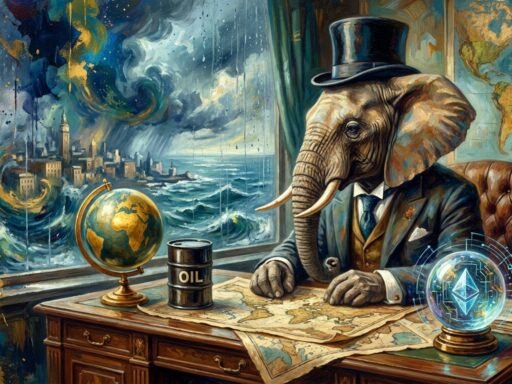



The global economy is currently digesting a series of severe macroeconomic and geopolitical shocks, forcing financial markets to recalculate risk and asset valuations. For long-term investors, periods of sudden volatility often resemble a stampede, creating noise that obscures underlying market fundamentals. Elephants know that navigating these conditions requires strict adherence to due diligence and patience, evaluating structural changes rather than reacting to daily price swings. The current climate is defined by shifting trade policies, capital-intensive technology investments, and a reassessment of global supply chains.
Geopolitical escalations and energy market impacts
The sudden collapse of recent diplomatic agreements in the Middle East has injected immediate volatility into global energy markets. Following a US airstrike that killed Iranian Supreme Leader Ayatollah Ali Khamenei, the incoming US administration formally dissolved the interim nuclear agreement and signaled a return to maximum pressure policies. Military activity in the Strait of Hormuz has escalated, resulting in a spike in crude oil prices and disruptions to commercial shipping lanes.
This renewed geopolitical focus on the Middle East directly impacted equity markets in Asia. Bloomberg reported that South Korean stocks fell in early trading as investors assessed the potential long-term impacts on global trade routes and energy stability. Concurrently, protracted conflicts in Ukraine, Sudan, and Mali continue to stretch international defense and humanitarian resources. In Ukraine, forces are monitoring the northern border with Belarus while conducting incursions into Russia’s Kursk region, straining equipment supplies and prompting requests for additional air defense systems.
Shifting European economics and trade policies
Europe is navigating overlapping political changes and economic stagnation. The UK is holding by-elections following the resignation of Prime Minister Keir Starmer and the subsequent resignation of Nigel Farage from Parliament. In France, Marine Le Pen has formalized her 2027 presidential campaign and actively distanced her party from Germany’s Alternative for Germany.
Germany itself is experiencing a severe industrial contraction. DW News notes that high energy prices, a persistent labor shortage, and the constitutional debt brake are restricting state borrowing and stalling economic growth. German manufacturing is facing intense competition from China in the automotive and renewable energy sectors. Across the continent, trade anxieties are rising as the incoming US administration threatens to sever trade relations with Spain and heavily criticizes European defense spending.
Trade relationships are also facing scrutiny in South Asia. DW News highlights that Pakistan’s economic stability relies heavily on the European Union’s Generalised Scheme of Preferences Plus status, which grants duty-free access for Pakistani textile exports. This relationship requires Pakistan to comply with strict international labor and environmental conventions, creating ongoing pressure from EU compliance assessments.
The semiconductor sector and artificial intelligence capital expenditures
The technology sector is experiencing a broad equity sell-off as market participants scrutinize the massive capital expenditures required for artificial intelligence infrastructure. Investors are questioning the timeline for AI profitability and the resilience of power grids tasked with supporting advanced data centers.
Despite this sector-wide anxiety, specific hardware manufacturers continue to secure capital for expansion. South Korean semiconductor manufacturer SK Hynix executed a record-sized US dollar bond offering to fund the production of high-bandwidth memory chips. During the company’s US market debut, Bloomberg reported that SK Hynix shares rose as the chief executive officer stated the global memory chip shortage will continue due to sustained AI hardware demand.
The pursuit of AI capabilities is also driving regional mergers and acquisitions. Channel News Asia reports a surge in Asia-Pacific dealmaking as organizations execute strategic buyouts to secure specialized AI intellectual property and integrate advanced technological capabilities.
Global monetary policy and fixed-income market shifts
Bond markets are adjusting to evolving economic data and central bank policy projections. In Japan, yields on 20-year and 30-year government bonds decreased as the debt instruments experienced a notable rally. Bloomberg indicates that increased purchasing activity was led by domestic institutional investors, particularly life insurance companies adjusting their portfolios amid speculation regarding the Bank of Japan’s timeline for interest rate adjustments.
In the US, Treasury yields continue to fluctuate. Market participants are analyzing real yields – nominal rates adjusted for inflation – to evaluate asset valuations and portfolio positioning. Analysts are balancing steady labor market indicators against the Federal Reserve’s stance on maintaining a higher-for-longer interest rate environment to stabilize consumer prices.
Resource constraints and supply chain pressures
Weather anomalies and regulatory debates are stressing global resource supplies. In Indonesia, retail prices for rice reached record highs. Channel News Asia reports that dry weather driven by the El Nino climate phenomenon has delayed planting seasons and reduced crop yields. The Indonesian government is attempting to stabilize the market by increasing grain imports and distributing food aid to low-income households.
Energy security remains a primary concern in the UK. The developer of the North Sea Jackdaw gas field warned BBC News that the country faces a risk of winter fuel shortages if the project is not approved. The development is at the center of ongoing negotiations regarding immediate domestic energy requirements and long-term emission reduction targets.
Labor dynamics are also shifting in rapid-delivery markets. India’s quick commerce sector is expanding rapidly, with platforms promising ten-minute grocery deliveries. France 24 reports that delivery riders are facing high accident rates and physical exhaustion. Operating as gig workers, these couriers lack basic labor protections and formal employment contracts, raising questions about the operational sustainability of ultra-fast delivery models.
Corporate strategies in technology and niche markets
Companies are adjusting their operational models to capture specific consumer segments and navigate regulatory frameworks. Uber is advancing a super app strategy by integrating Expedia hotel bookings directly into its platform. Launching initially as a pilot in the UK, the Financial Times notes that the partnership allows Uber to access a massive global database of accommodation options without managing hotel inventories.
In the digital asset space, cryptocurrency exchange Binance is pursuing new regulatory licenses across several Asian jurisdictions. According to Channel News Asia, the company aims to align its operations with local compliance standards to capture rising digital asset adoption in the region.
Niche luxury markets are experiencing strong price appreciation driven by strict import rules and agricultural shifts. The Wall Street Journal reports that restored vintage Land Rover Defenders are selling for $170,000 in the US. Restoration firms utilize a federal exemption allowing the importation of foreign vehicles older than 25 years, bypassing modern safety and emissions standards that restrict newer foreign models. In Asia, agriculturalists in Taiwan are transitioning from tea cultivation to premium Arabica coffee production. Channel News Asia details how beans grown in the high-altitude Alishan region are fetching exceptionally high prices at international auctions.
Urban economies are also transforming rapidly. Nashville, Tennessee, is navigating a severe housing crisis driven by a boom in the local tech and healthcare industries. The Financial Times reports that soaring property values are displacing long-term residents and local musicians, forcing the city to address infrastructure and transit constraints.
Elephant Conclusions for the Herd
The current macroeconomic environment requires the herd to remain steady and avoid reacting to short-term geopolitical panic. The renewed conflict in the Middle East and its immediate impact on crude oil prices demonstrate why diversification across traditional energy and defense sectors can provide stability when diplomatic agreements fail.
The artificial intelligence sector is undergoing a necessary market correction. Investors are shifting their focus from conceptual growth to concrete profitability timelines. While broad tech indices may experience sell-offs, the underlying hardware demand remains absolute, as evidenced by SK Hynix’s ability to secure massive capital for memory chip production. Elephants investing in technology infrastructure must maintain a multi-year horizon, recognizing that building the physical data centers and power grids required for AI takes time and immense capital.
Finally, the fixed-income market is offering clear signals. The rally in long-term Japanese government bonds and the stabilization of US Treasury real yields indicate that institutional capital is locking in current rates. As central banks maintain higher-for-longer monetary policies, fixed-income assets provide a reliable watering hole for capital preservation while equity markets digest ongoing trade tariffs and global supply chain realignments. Strict financial discipline and deep fundamental research remain our strongest tools.
This article was generated by AI based on news reporting from the past week. Please perform your own due diligence before making investment decisions.